
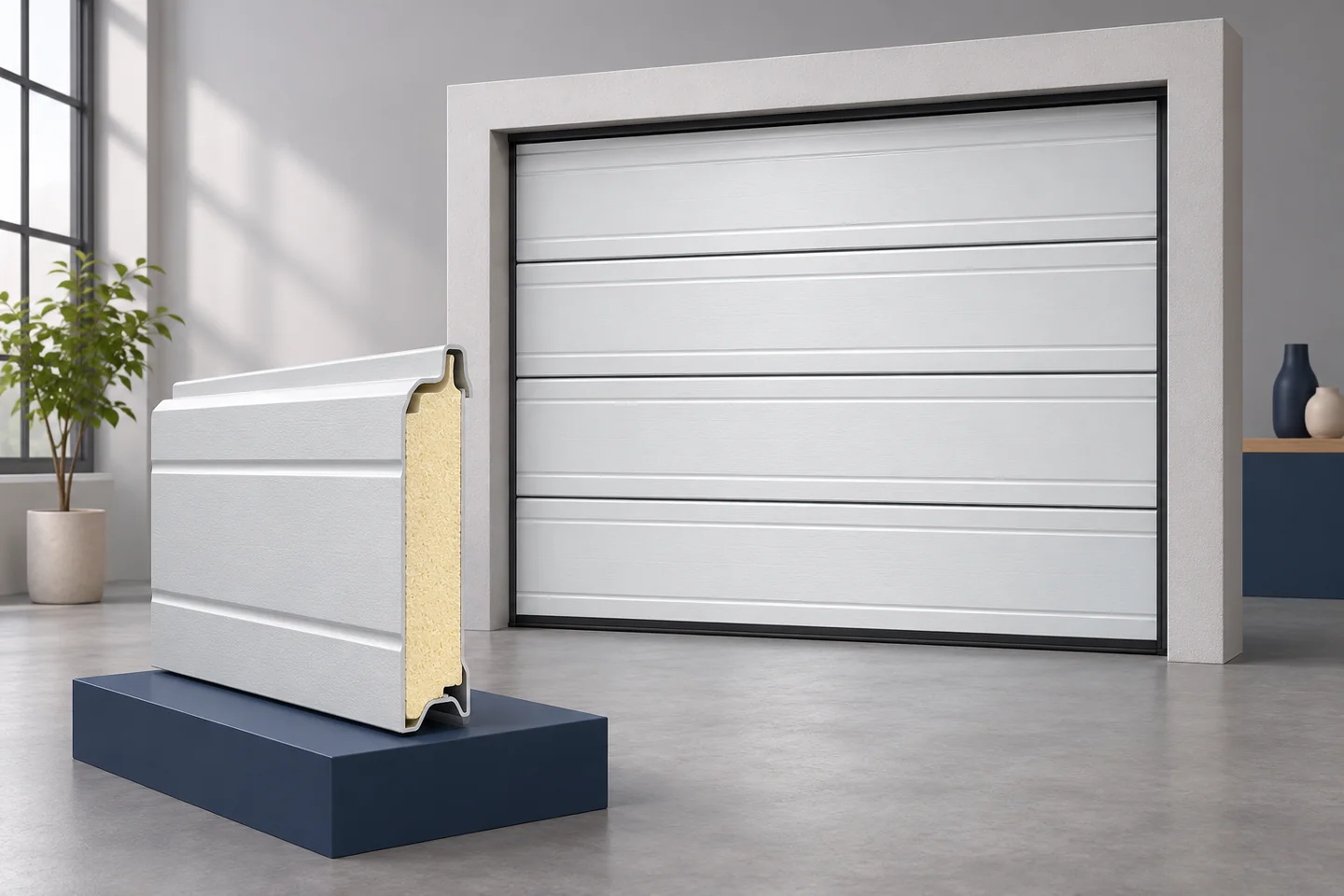
A garage door R-value can help describe a section's resistance to heat flow. A tested whole-door U-factor describes heat transfer through an assembled door. They answer different questions, so the largest R-value in a brochure does not, by itself, identify the best-performing complete door.
For dealers, builders and project buyers, the useful comparison starts with the evidence behind the number. Check the measurement scope, units, method and door configuration before putting two thermal ratings in the same quotation table. This guide provides a document checklist and an illustrative supplier comparison, without assigning an unverified rating to a SEPPES product.

What does a garage door section R-value tell you?
R-value expresses thermal resistance. Within a comparable measurement scope and unit system, a higher figure means more resistance to heat flow. In the sectional garage door method described by DASMA, the published section value is calculated from the section's construction. It is not a test of every part of the installed door.
Use that distinction when reading a sandwich-panel description. A panel thickness, a foam description and a calculated section R-value are separate pieces of information. Ask what the stated figure includes and how it was obtained. Keep the source document with the quotation so a later change in construction can be reviewed against the original proposal.
What does a tested whole-door U-factor tell you?
U-factor expresses thermal transmittance. For comparable door assemblies tested on the same basis, a lower U-factor indicates less heat transfer. A whole-door test considers the assembly rather than only the centre of an insulated section. The sections, their connections and other elements included in the test form the reported result.
ANSI/DASMA 105 is the garage door test method referenced by the DASMA Thermal Performance Verification Program. Request the actual method and report identity instead of accepting a brochure's use of tested as a complete explanation. A statement about a test method is also different from evidence that a particular model is listed in a verification program.
Compare the rating basis before comparing the number
Use the following table as a reading aid. It describes the section-calculation and assembly-test distinction used in DASMA guidance; it does not establish a rating for any product. If a supplier uses another method, ask for that method's scope and terminology.
On a small screen, scroll the table sideways to read every column.
| Check | Calculated section R-value | Tested assembly U-factor |
|---|---|---|
| What is described? | Resistance associated with the specified door section | Heat transfer through the door assembly included in the test |
| Which direction is better? | Higher resistance, on a comparable basis | Lower transmittance, on a comparable basis |
| What should accompany it? | Construction details, calculation basis and units | Test report, method, specimen description and units |
| What needs checking? | Whether the figure covers insulation alone or the stated section | Whether the proposed configuration is covered by the evidence |
| What should not be inferred? | A verified whole-door rating from a panel figure | Air leakage, acoustic performance or an energy-saving percentage |
Why converting a panel R-value does not produce a tested door U-factor
Taking the reciprocal of an advertised section R-value does not create a tested whole-door U-factor. The two garage door figures described above come from different assessment scopes. A calculator cannot supply the missing assembly test or show that its result applies to the door being ordered.
Keep the units visible as well. If reports use different unit systems, have the values checked on a consistent basis while retaining the original documents. A unit conversion changes how a value is expressed; it does not change what was assessed, add omitted components or turn a calculated value into a verified test result.
Check glazing, connections and air leakage separately
A complete door includes more than its insulating core. Section interfaces, supporting details and thermal breaks can affect the heat-transfer path. That is why a panel description should not stand in for the assembly evidence. When comparing a solid door with a glazed configuration, ask which construction the reported result covers.
Air leakage is a separate consideration. The DASMA thermal verification program does not establish an air-infiltration or solar-heat-gain result through its U-factor listing. If either is relevant to the project, request the corresponding evidence and assessment scope. Do not treat one thermal document as proof of every weather-performance requirement.
Record the proposed glazing arrangement, perimeter details and installation responsibilities in the enquiry. Ask the reviewer to identify which changes need additional evidence. This is a specification review, not a suggestion to modify seals, hardware or safety-related components on an installed door.
An illustrative comparison: two offers, different evidence

Imagine that Offer A gives a section R-value but no assembly report, while Offer B supplies a whole-door U-factor report for an identified specimen. Neither description is enough to rank the proposed doors until the documents and configurations have been checked. This is an illustrative purchasing exercise, not a customer case or a comparison of actual suppliers.
For Offer A, request the construction, calculation basis and any applicable assembly evidence. For Offer B, check the report's model, specimen and configuration against the enquiry. If the order includes a different glazing layout or another construction change, ask for written confirmation of the report's applicability rather than assuming the figure transfers.
Give each offer a document status: relevant evidence received, applicability awaiting confirmation, or required evidence unavailable. Ask the project's responsible reviewer to resolve the open items before approving a performance requirement. A clear pending status is more useful than filling an empty cell with a converted or borrowed number.

Thermal document checklist for a supplier enquiry
Send the performance question with the proposed door configuration. The following checklist is an editorial purchasing aid. It helps a supplier identify the evidence available and the questions that still require a project-specific review.
- Identify the project location, intended garage use and the person responsible for accepting the thermal requirement.
- State the required metric and units, and attach the relevant project specification when available.
- Request the exact model and construction proposed, including the section type and glazing arrangement.
- Ask whether each figure describes insulation, a section or a complete door assembly, and whether it is calculated or tested.
- Request the document identifier, date, issuing laboratory or author, method used and specimen description.
- Ask how the supplier establishes applicability to the proposed order, including any differences from the reported configuration.
- Request separate information for air leakage or other performance requirements instead of assuming the thermal value covers them.
- Record unavailable documents and unresolved questions explicitly; agree who must review them before the order specification is accepted.
When enquiring with SEPPES, start with the insulated steel sectional door page and send opening details, quantity, destination and the required evidence. Ask which documents are available for the proposed configuration. This article establishes no model-specific R-value, U-factor, program listing or certification.
Frequently asked questions
Is a higher garage door R-value always the better choice?
A higher R-value means greater resistance only on a comparable basis. Check what was assessed, the method, units and construction. A section figure alone does not rank complete doors or establish suitability for the project.
Can I calculate a whole-door U-factor as 1/R?
The reciprocal of a published section R-value is not a tested whole-door U-factor. It cannot replace assembly evidence or confirm applicability to the configuration being ordered.
Does the U-factor also prove that the door is airtight?
No. Heat transmittance and air leakage are different performance questions. Request the applicable air-infiltration information separately when the project requires it.
Can I use the solid-door result for a door with windows?
Ask the supplier to establish whether the evidence covers the proposed glazing configuration. Do not assume that every solid-door result applies unchanged to a different window arrangement.
Does a DASMA reference mean the SEPPES door is verified by that program?
No. This guide references industry guidance to explain evaluation methods. A claim of program participation or a verified model rating requires the corresponding model-specific listing and evidence; none is established here.
Which R-value should I specify for my project?
This guide sets no universal target. Ask the responsible project reviewer to define the required metric, units and acceptable evidence for the location, building use and proposed assembly before requesting a matching configuration.
Compare the evidence, then specify the door
Keep three questions together: what does the number describe, how was it obtained, and does the evidence cover the door being proposed? A higher section R-value and a lower tested assembly U-factor are useful only when their different meanings remain clear. Use the checklist to turn a general insulation enquiry into a configuration and document review.
Sources
Industry references explain assessment methods. They do not establish SEPPES model ratings, program participation or project compliance. Sources were checked on 13 November 2026; document revision dates remain separate from this review date.